Why More Gauteng Companies Are Choosing Country Venues for Conferences
Thinking beyond the hotel boardroom? Here's why Gauteng country estate conference venues boost engagement, creativity, and team morale — with practical tips for planners.
Why More Gauteng Companies Are Choosing Country Venues for Conferences
There is a pattern that anyone who has organised a corporate conference will recognise. You book a hotel conference room in Sandton or Rosebank. The room has grey carpet, fluorescent lighting, and a projector that requires three calls to IT to connect. By 2pm, half the delegates are checking their phones. By 3pm, the energy in the room has flatlined.
The problem is not the content. The problem is the container.
An increasing number of Gauteng businesses — from mid-size companies hosting strategy sessions to large corporates running multi-day leadership programmes — are moving their conferences out of city hotels and into country estate venues. The reason is simple: environment shapes behaviour. Change the setting, and you change the outcome.
The Science Behind the Setting
This is not a fluffy claim. Research in environmental psychology has consistently demonstrated that natural settings reduce cortisol levels, improve attention spans, and increase creative thinking. A landmark study published in the Journal of Environmental Psychology found that even brief exposure to natural environments significantly improves cognitive function compared to urban settings.
For a conference organiser, this translates into tangible benefits:
Higher engagement. When delegates step outside between sessions and see gardens, water, and sky instead of a parking garage, their cognitive batteries recharge faster. Afternoon sessions start with more energy, not less.
Better creative output. If your conference includes brainstorming, strategy, or design thinking workshops, a natural setting measurably improves the quality of ideas generated. The combination of reduced stress and increased cognitive flexibility produces better outcomes than the same exercise in a windowless boardroom.
Improved team dynamics. Informal spaces — a garden, a terrace, a lounge overlooking water — create opportunities for the unstructured conversations where real relationship-building happens. These conversations rarely happen in a hotel corridor.
What a Country Estate Conference Looks Like
If you have not hosted a conference outside a traditional hotel or conference centre, here is what a typical day looks like at a country estate venue:
Morning arrival. Delegates park in on-site parking and walk through gardens to the conference space. Coffee and pastries are served on a terrace or in a garden lounge rather than in the conference room. The first twenty minutes set a different tone from the start — people talk, they notice the setting, they relax.
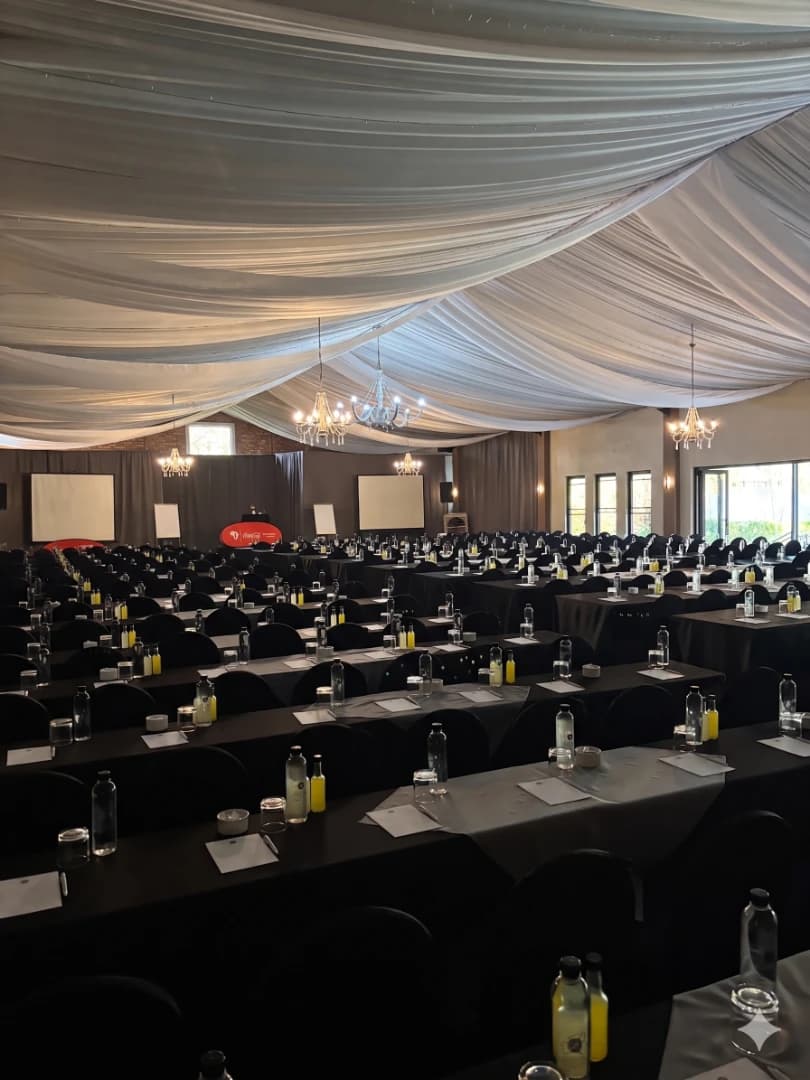
Morning session. The conference hall has natural light, high ceilings, and views of trees or water. AV equipment is set up and tested in advance. The room is configured to your specification — boardroom style, U-shape, classroom, cabaret, or theatre. The absence of generic hotel noise (lobby traffic, other conferences, elevator dings) means your speaker has the room's full attention.
Tea break. Served in the gardens or on the terrace. Fifteen minutes of fresh air and birdsong between sessions. Delegates return noticeably more alert.
Lunch. A seated lunch or buffet in a separate dining area. Country venue catering tends to be more characterful than hotel function catering — think freshly prepared food with local ingredients rather than the generic hotel conference menu that exists in every Hilton and Protea worldwide.
Afternoon session. If the programme includes team building, the estate grounds offer space for outdoor activities that do not feel forced. Lawn games, guided walks, problem-solving challenges using the natural environment. If the afternoon is content-heavy, the natural light and ventilation in the hall keep energy levels stable.
Sundowner. After wrap-up, a drinks session on the lawn or beside the river. This is where the real networking happens. In a hotel, delegates scatter to their rooms or leave immediately. At a country estate, they linger.
Optional overnight. For multi-day conferences, on-site accommodation means no one is driving home after dinner. It also means evening social sessions flow naturally without the logistics of shuttle buses to external hotels.
Practical Considerations for Planners
Choosing a country estate over a hotel conference room requires thinking through a few logistical factors:
Travel time and access. The venue needs to be close enough that delegates do not lose half the morning in traffic. Anything more than 60 minutes from the office crosses the line from "refreshing change of scenery" to "annoying commute." Ideally, aim for 30 to 45 minutes. The East Rand is a sweet spot for many Gauteng companies: Johannesburg-based delegates can reach Springs in roughly 45 minutes via the N17, and it is only about 20 minutes from OR Tambo for delegates flying in from other provinces.
AV and connectivity. This is the area where country venues historically fell short. Modern estates have invested heavily in this gap. Confirm: is there Wi-Fi that can handle 50+ simultaneous connections? Is the projector HD? Is there a sound system for the room, or do we need to bring one? Is there a technician on-site? Do not assume — test during your site visit.
Catering flexibility. Corporate dietary requirements are more varied than they were a decade ago. Confirm the kitchen can accommodate halal, kosher, vegetarian, vegan, gluten-free, and allergy-specific requirements without making it feel like an afterthought.
Breakaway spaces. If your programme includes small group work, you need separate spaces. A single large hall is not enough. Look for venues that offer a main conference room plus two to three smaller breakaway areas, ideally with different atmospheres (one indoors, one outdoors, one semi-covered).
Parking and security. Can the venue handle your vehicle count? Is parking secure? Is there a dedicated entrance for delivery vehicles (signage, equipment, supplies) that does not interfere with delegate arrival?
The Cost Comparison
A common assumption is that country estate venues are more expensive than hotel conference rooms. In many cases, the opposite is true.
A standard Sandton hotel conference package for 50 delegates — room hire, two teas, lunch, and basic AV — runs R600 to R900 per person per day in 2026. A comparable package at a country estate venue on the East Rand or in Muldersdrift runs R450 to R750 per person, often with better food, more space, and exclusive use of the grounds.
Where country venues can cost more is in accommodation (if the hotel would have offered a conference-and-stay package discount) and in team-building add-ons. But these costs are typically offset by lower base rates and the absence of Sandton parking fees.
The real value argument, however, is not about price — it is about outcome. If your conference achieves better engagement, produces better ideas, and leaves your team more energised, the ROI dwarfs the difference between R600 and R700 per person.
Choosing the Right Country Venue
Not all country estates are created equal as conference venues. Here is what separates a great corporate venue from one that is beautiful but operationally frustrating:
Operational professionalism. The venue should have experience hosting corporate events, not just weddings. Corporate clients need timelines honoured, AV that works, and coordinators who understand that a 9am start means ready at 8:45, not "we'll begin setting up at 9."
Layout versatility. A venue that can only offer one room configuration is limiting. Look for halls where the furniture can be rearranged for different session formats throughout the day.
Reliable infrastructure. Generator backup (load shedding is a reality in South Africa), strong Wi-Fi with a dedicated business line (not shared with accommodation guests), and climate control (heating for winter conferences, cooling or ventilation for summer).
Professional catering. Conference catering must be efficient. Delegates have limited time for meals, and a slow buffet or disorganised plated service eats into your programme. The kitchen needs to serve 50 to 100 people quickly without compromising quality.
A coordinator who understands corporate events. The person managing your conference day should speak the language of corporate events: run sheets, AV requirements, dietary manifests, branding guidelines. If the coordinator only talks about centrepieces and confetti, you are in the wrong venue for a corporate event.
When a Country Estate Makes Most Sense
Country estate conferences are particularly effective for:
Strategy and planning sessions where you need your team thinking differently. The change of environment breaks established thought patterns.
Leadership development programmes where relationship-building and candid conversation are goals. The informal spaces of a country estate facilitate the kind of trust-building that hotel breakout rooms cannot.
Team-building days where outdoor activities are part of the programme. You have gardens, lawns, and natural terrain at your disposal rather than a hotel car park.
Year-end functions and awards evenings where you want to celebrate your team in a memorable setting. A country estate at sunset, with dinner in a beautiful hall and drinks on the lawn, creates an experience that people genuinely enjoy — unlike yet another hotel ballroom dinner.
Multi-day conferences where delegates stay on-site. The continuity of being in one place — no commuting, no packing up, no lost time — makes multi-day programmes significantly more productive.
Riverside Country Estate hosts corporate conferences for 30 to 350 delegates in our Willow Hall and Wisteria Hall. We are 45 minutes from Johannesburg and 20 minutes from OR Tambo, with on-site accommodation, full AV setup, and a dedicated events team.
Explore our conference spaces → or view corporate packages →
Frequently asked questions
Why choose a country estate for a corporate conference in Gauteng?
Country estates remove delegates from office distractions and create a focused environment that improves engagement and creative thinking. Research consistently shows that delegates in natural settings report higher satisfaction and better retention of content than those in urban hotel conference rooms. For Gauteng companies, estates within 45 to 60 minutes of the city offer this benefit without significant travel burden.
What facilities should a Gauteng conference venue have?
Essential facilities include full AV equipment (projector, screen, microphone, sound), high-speed Wi-Fi, natural light in meeting rooms, flexible room configurations, on-site catering, and ample parking. On-site accommodation is important for multi-day events. Riverside Country Estate offers all of these at a venue 45 minutes from Johannesburg.
How much does a conference venue cost in Gauteng?
Conference venue hire in Gauteng varies widely based on delegate count, facilities, and duration. Day delegate rates at country estates typically range from R350 to R700 per person including venue hire, AV, catering, and tea breaks. Contact Riverside Country Estate directly for current day delegate rates and package options.
Ready to start planning your event at Riverside?